Showing posts with label Research In Progess. Show all posts

Thursday, 25 May 2017

Pot Sampling - Day Four

Today was the final day of sampling. We had 7 more pots to harvest. This meant more digging out of the little meshes and more washing of roots. The difference between these pots and the ones we harvested on day two because these barley plants do not grow root hairs. The inside of the pots look very similar because the root hairs are very tiny and you need a microscope to see them properly.

Laurie used a penetrometer to measure the strength of the soil in the pot. It's smaller than the one they used in the field.
This is the end of our work in Dundee and we celebrated by eating an ice cream. Tomorrow we head back to Southampton.

Monday, 22 May 2017

Field Sampling - Day Three

It was the final day of field sampling today. A large group of us met up at one of the barley plots on a lovely sunny morning and split into small teams. Tim and Laurie used a penetrometer to measure how hard the soil was, Paul and Naveed took some more soil core samples, Nico and Glyn collected small soil samples with roots, which it was my job to coat with plaster of paris to protect them. This was a tricky job as the soil samples were very fragile and the plaster of paris dried very quickly.
The sampling started off well, although having spent so much time in the lab looking a idealised soil samples, we had forgotten that real soil in fields contains stones, which can make sampling challenging. 


It was great to be outside in the sunshine, however, it began to rain. We all carried on with our task, but as my hands got cold the coatings of plaster of paris I was applying got messier!

After lunch the sun came out again. Nico and I moved to the second barley plot to collect samples from there. The soil in this plot was more crumbly that the first as it contained less clay. The soil samples were so fragile Nico couldn't even lift them from the soil without them collapsing. So we tried putting on the plaster of paris while they were still in the field. This was very tricky and was virtually impossible to do without disturbing the soil. In the end we gave up as we were damaging the sample too much while trying to preserve them.


Friday, 19 May 2017

Field Sampling - Day Two

While I was washing out the roots, Nico and Naveed were in the field collecting soil cores. To do this the first thing they did was cut off the top of the plant they wanted to sample.

Then they positioned an auger containing an aluminium sampler over the top of the plant.


Next they used a large hammer to push the auger into the ground.


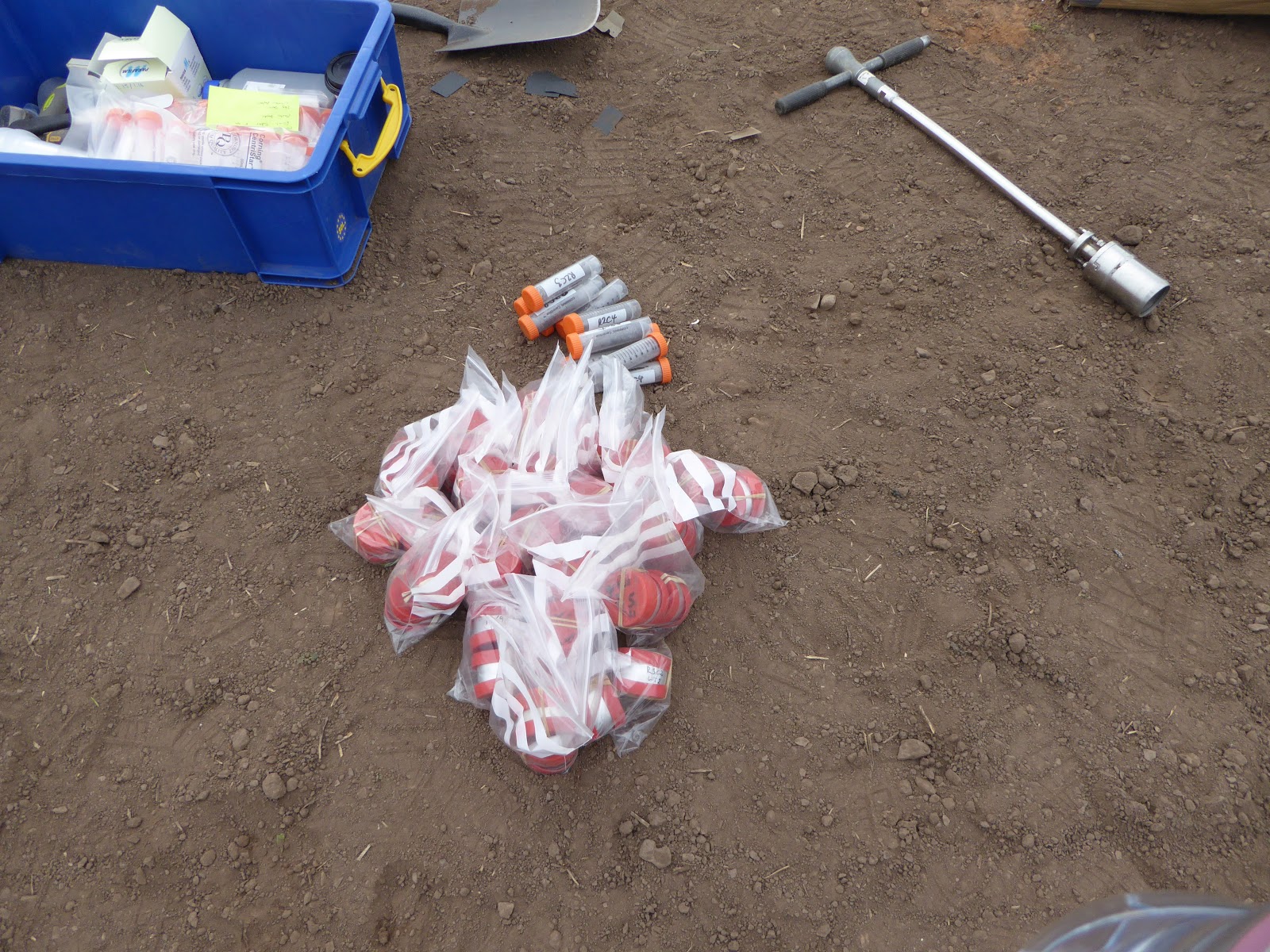
Finally, they removed the aluminium sampler from the auger and put a red lid on the top and the bottom to stop it moving around.


They did this many times all over the field and by the end of the day had collected lots of samples.


Pot Sampling - Day Two

Today we began collecting samples. We split into two groups. Some people collected samples from the large pots, others collected samples from the field. I was part of the pot sampling group.

First of all, we opened up one of the large pots. In this picture you can see the cylinder of soil that was inside and some of the roots of the plants. Nico is taking a small soil sample from different depths inside the pot.

This sample is then weighed. Once it has dried it will be weighed again so that we can work out how much water was in the soil when we opened it.

 Here are all the glass jars that were prepared for collecting samples. As you can see there is a lot to do!

After these small soil core had been taken, we dug into the soil to remove small cylindrical meshes that had been put in there before the plants grew. This is so we could collect small samples of soil with roots in. Some of these will be x-rayed to see how the roots interact with the soil. Here are the mesh cylinders before they were filled with soil and one after it had been dug up.


The samples that were not being x-rayed were washed so the roots could be separated from the soil. This was my job. Here is the washing station. There is a hose attached to each tap. I emptied each of the mesh cylinders into a sieve and then used the hose to wash the soil away from the roots. I then put the roots in ethanol - a chemical that preserves the roots until they can be studied.

I'm not very experienced at this sort of thing and I had a big mistake - I let go of the hose while the tap was on. Water went everywhere including all over me! Here is a picture of me looking bedraggled!

 Tim to do the same thing as me, except he had to do it for the rest of the soil in the pots, so he had big buckets of soil and roots to clean up.


 In every experiment it is important to have a control. This is a sample that you don't do anything to. I our case this meant a pot with no plant in. In the control the soil looks really smooth.


 It took all day to wash out all the root. But my favourite part was cleaning up at the end of the day because we had to get rid the soil that we had washed away. And what do you get if you mix soil and water? Lots of lovely sticky mud!

Thursday, 18 May 2017

Field and Pot Sampling - Day One

Today, Nico and I travelled up from Southampton in England to Dundee in Scotland, a distance of 388 miles (624 kilometres)! We are going to stay for a week to help gather some sample from field and large pot experiments that Tim and Laurie at the James Hutton Institute have grown for us. When we arrived we were given a tour of the site and shown the plants.
Here is a photo of the barley plants on the field. There hasn't been much rain in Dundee over the last few weeks, which is unusual, so the plants are quite small.

Here are barley plants that have been grown in a large pot. This pot has been in the glasshouse, a giant green house, and has been water regularly. As you can see it is much bigger than the plants in the field. Tomorrow, we will get to work harvesting the samples that we need.

Saturday, 11 June 2016

Day 2 - Scanning Trip June 2016

We worked through the night scanning samples. This morning we began the second experiment. For each sample a sweetcorn seed, which has been germinated - this means it had started to grow a root, is stuck to a plastic fitting using plaster of paris. The root is fed through a hole in the fitting so a little bit sticks out the end. A syringe barrel filled with soil is then attached to the fitting and the whole thing is put in the scanner. We are scanning the root every 6 minutes so we can see how it interacts with the soil particles as it grows.

So far the experiments have been running pretty smoothly and we have been seeing some good results.

Day 1 - Scanning Trip June 2016

Yesterday we made lots of preparations for the experiments we were going to run. I got the fun task of having to separate chia seeds from the mucilage that they release when they are mixed with water. To do this the chia seeds had to be soaked in water for four hours. Then I poured them into a large syringe. I emptied the syringe against a sieve to separate the seeds from the mucilage. The mucilage is strongly bound to the seeds so I had to apply a lot of force to get the mucilage to go through the sieve. If I didn't press hard enough the seeds and mucilage squirted out of the side of the syringe. One time when this happened I ended up with quite a lot of chia seeds stuck to the wall!
Here is a picture of the syringe and the sieve I was using. Underneath the sieve there is a plastic pot to catch the mucilage.

This is a picture of the chia seed and their mucilage.

Once I had separated the seeds from the mucilage I then had to use a pair of tweezers to pick out all the bits that had managed to pass through the sieve. This was quite difficult. It was like having to pick the solid bits out of a very large bogey!

Sam, who was in charge the experiments, showed us how they should be carried out and we started the first one. This was pretty simple. Put the sample in the scanner, scan it at three different heights and then repeat with the next sample.

Friday, 10 June 2016

The Swiss Light Source

This week myself and a team of researchers from the University of Southampton have travelled to Switzerland to conduct some experiments at the Swiss Light Source (SLS). The SLS is part of the Paul Scherrer Institute (PSI). It is the large round building in the picture below:

www.psi.ch
In the center of the SLS is a particle accelerator. Electrons are made to spin around a ring, getting faster and faster. When they reach a high enough speed they are released out of the different 'beamlines' and scientists use these released electrons of conduct experiments. 

The inside of the building looks like this: 
www.psi.ch
We are using one of the beamlines called TOMCAT to x-ray fungi and roots within soil samples. We use the electrons to create a super bright light that means we can image a soil sample in a few minutes.

You can find out more about the SLS at their website:
https://www.psi.ch/sls/
and the TOMCAT beamline:
https://www.psi.ch/sls/tomcat/tomcat